Fixtures in your hands in days, not weeks.
Custom soft jaws, locators, drill jigs, CMM fixtures, and welding fit-ups in engineering thermoplastics — carbon- and glass-reinforced nylons, PPS-CF for coolant-flooded work, PC-FR, ASA-CF, ESD grades. Send a STEP file. We quote, print, and deliver.
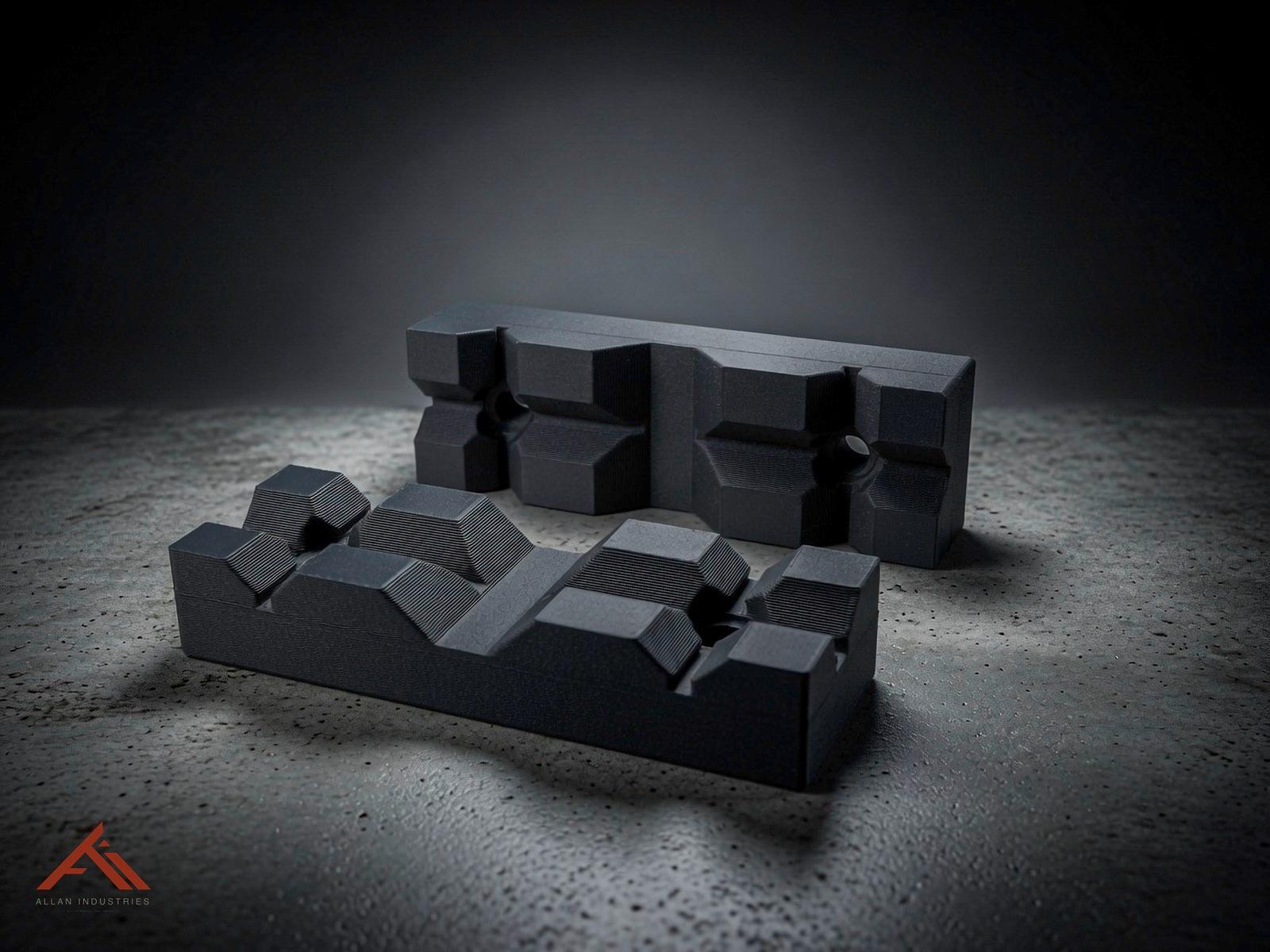
Every shop has the same problem.
The work that pays the bills is the work running on a spindle. Every fixture, jig, soft jaw, locator, and welding fit-up is a job that has to happen before the paying work starts. Most shops handle it one of three ways.
Your machinists spend hours or days cutting fixtures from aluminum or steel. Revenue-generating capacity burned on tooling for your own jobs.
Two to six weeks lead time is normal. For one-off or custom fixtures, you pay setup costs on top of material and machining.
Reuse something that almost fits. Hold a part by hand. Skip the locator and eyeball it. This is how scrap rates climb and operators get hurt.
There's a fourth option. Outsourced FFF additive manufacturing — a fixture in your hands in days, not weeks, made from engineering-grade thermoplastic, at a price that often beats your own machinist's hourly cost. The case studies below show what shops have actually saved doing it.
Industry-documented results.
Eight published case studies across machine shops, OEMs, and Tier-1 suppliers. Cost reductions of 70–90%. Lead-time reductions of 40–90%. Consistent enough across application types to be treated as the working benchmark for what FDM fixture work delivers.
| Shop | Application | Result |
|---|---|---|
| Thogus Contract manufacturer | 12-cavity CMM fixture | $1,500 → $200 in materials. 7–10 days → overnight. |
| BMW OEM auto | Rear name-badge assembly tool | $420 / 18 days → $176 / 1.5 days. 58% cost, 92% time reduction. |
| Thermal Dynamics Equipment manufacturer | 6 production fixtures | $12,000 / 7 days → $2,040 / 4 days. 83% cost, 42% time reduction. |
| Solaxis Tier-1 auto supplier | Door-seal assembly jig | 150 lb metal → 28 lb FDM. 16–20 wk → 3–5 wk design/manufacturing cycle. ROI in 12 months. |
| Genesis Systems Robotics integrator | Waterjet end-effector grippers | 85% time reduction, 94% cost reduction. 35 lb → 3 lb. |
| Joe Gibbs Racing NASCAR team | Pit fixtures | Cost and lead time cut by ~70% on average. Multiple fixtures in service 2+ years. |
| Alseca Engineering Tooling shop | Vacuum-forming tooling | Tooling lead time: 3–4 weeks → 3–4 days. |
| Oreck Consumer manufacturer | CMM first-article fixtures | Setup time and 30-day test cycle dramatically reduced. |
Source: Stratasys industry case studies, published in white papers across the 2014–2022 period. Allan Industries runs the same material classes on production-grade FDM hardware — these are industry benchmarks for the FDM fixture category, not Allan Industries' own results. Our own case studies will appear here as we publish them.
Build the fixtures that didn't pencil out before.
Most shops run fewer fixtures than they should. Not because the value isn't there — at machine-shop pricing, a fixture that saves two seconds per cycle or one percent of scrap doesn't justify the machinist hours to build it. So it doesn't get built. The job runs slower, with more scrap, and everyone accepts it as the cost of doing business. At FDM pricing, the math changes.
A fixture shaving two seconds per cycle, run 500 times a day by one operator over a 250-day working year, frees 70 hours of direct labor — about a week of capacity back.
A fixture that cuts scrap by one percent on a line running 125,000 parts a year saves 1,250 parts annually — material, labor, and the cycle time to remake them.
One printed fixture preventing half a day of unplanned downtime on a $1,200/hour shop is $4,800 recovered. Automotive OEMs report downtime costs averaging $22,000/minute at scale — even a few minutes saved usually exceeds the entire fixture cost.
The Solaxis case illustrates this concretely: a 4-second cycle-time savings on a door-seal assembly fixture, at 250,000 cycles/year per worker, paid back the entire fixture cost in 12 months. That fixture was never going to get justified at machined-aluminum prices.
The pitch isn't that we're cheaper than a CNC-machined fixture, though we usually are. It's that at our price, every fixture that improves your operation by a few seconds or a few percentage points is suddenly worth building. That's a different conversation than "cheaper alternative to your machine shop's queue."
Engineering-grade FDM. Not a hobby printer.
A B2B additive manufacturing service based in Kansas City. We exist to take fixture, jig, and functional-part work off your shop's plate so your machinists can stay on revenue work. We run the same engineering thermoplastic classes Stratasys positions for their F900 and Fortus 450mc production printers — including carbon- and glass-reinforced nylons, PPS, PAHT, PPA, PC and PC-FR, ASA-CF, and the PET family.
Fused Filament Fabrication. Layer-by-layer extrusion of engineering thermoplastic.
Same classes Stratasys positions for their F900 and Fortus 450mc production printers — carbon and glass-reinforced nylons, PPS, PC, ASA-CF, PET family, ESD grades, TPU.
Working baseline. Tighter than ±0.10 mm requires careful design discussion or post-machining.
Per machine. Larger parts via multi-print assembly.
Instant quote on most parts. Next-day turnaround typical for fixtures under 24-hour print time.
The right material is the one that matches the actual job.
The lineup below is what we stock or commonly run; for one-off specialty materials, we source what the job actually needs. Every material listed is available stocked or overnight.
Toughness, fatigue resistance, high cycle count.
| Material | Use it for |
|---|---|
| PA612-CF15 carbon-fiber | Lower moisture sensitivity than PA6 or PA12, excellent stiffness. Direct equivalent to Stratasys FDM Nylon 12CF for most applications. |
| PA612-ESD ESD-safe | Same backbone as PA612 with electrostatic-dissipative additive. For electronics handling and PCB fixturing. |
| PA6 unreinforced | Maximum toughness and impact resistance. |
| PA6-GF20 / PA6-GF25 glass-fiber | Stiffer than unreinforced nylon while retaining nylon's fatigue resistance. |
| PA6-CF20 carbon-fiber | Higher stiffness-to-weight than glass-filled. |
| PA12-CF10 carbon-fiber | Lower moisture pickup than PA6. Dimensionally stable in humid environments. |
| PAHT-CF high-temp | High-temperature nylon, carbon-fiber filled. Continuous service to ~150 °C. |
| PPA-CF high-temp | Polyphthalamide, carbon-fiber filled. Highest continuous-service temperature in our nylon lineup (~180 °C). |
For coolant-flooded operations, solvents, and sustained heat.
| Material | Use it for |
|---|---|
| PPS-CF10 coolant-flooded | Polyphenylene sulfide, carbon-fiber reinforced. Chemically inert to virtually every machine shop fluid — coolants (semisynthetic, soluble oil, synthetic), cutting oils, solvents, acids, bases. 486.5 °F (252.5 °C HDT). The material for coolant-flooded turning fixtures and harsh chemical environments. |
| PPS-GF20 glass-fiber | Same chemical resistance as PPS-CF, different stiffness profile. |
Strong, dimensionally stable, impact-resistant.
| Material | Use it for |
|---|---|
| PC HDT ~138 °C | Welding fit-up jigs in moderate heat zones, structural workholding, parts that need impact resistance. |
| PC-FR flame-retardant | Flame-retardant polycarbonate. For applications requiring UL94 flame ratings. |
For fixtures exposed to sun or weather.
| Material | Use it for |
|---|---|
| ASA-CF08 UV-stable | UV-stable acrylonitrile styrene acrylate with carbon-fiber reinforcement. Both UV-stable and structurally rigid — materially different from standard ASA. |
General-purpose engineering workhorses.
| Material | Use it for |
|---|---|
| PET-CF17 carbon-fiber | Stiff, dimensionally stable, good chemical resistance to most non-aggressive shop fluids. Workhorse material for general fixture work. |
| PET-GF15 glass-fiber | Similar to PET-CF at lower cost, slightly lower stiffness. |
| PETG-CF carbon-fiber | Easier to print than PET-CF, slightly lower performance ceiling. For lighter-duty engineering fixtures. |
| PETG-ESD ESD-safe | Electrostatic-dissipative PETG for electronics handling. |
| PETG-rCF08 recycled CF | Recycled carbon-fiber PETG. For cost-sensitive applications where sustainability is a value-add. |
Soft-grip, non-marring, vibration-dampening.
| Material | Use it for |
|---|---|
| TPU 85A–95A elastomer | Soft-grip fixtures, paint-mask fixtures, non-marring workholding for finished or coated parts, vibration-dampening pads. |
Need something not listed? Any compatible engineering filament can be sourced overnight. For PEEK, PEKK, or PEI/ULTEM, see the limits section below — we'll refer you out to a Stratasys-tier shop.
Eight questions answer most of it.
If you'd rather just send us the part and let us recommend, that's fine — most quotes work that way. But for engineers who want to think it through before sending the file, this is the decision tree we use.
What's the load case?
Static clamping force only → PET-CF, PETG-CF, PA6-GF. Cyclic or fatigue → PA612-CF, PA6, PA6-CF. Impact or drop tolerance → PA6, PC. Sustained high load → PA612-CF, PAHT-CF, PPS-CF; if very high, CNC may be the better answer.
What's the chemical exposure?
Dry milling → most materials work. Light coolant mist → PET-CF, PA-CF, PA-GF all fine. Coolant-flooded immersion → PPS-CF10 or PPS-GF20, chemically inert. Aggressive solvents or acids → PPS. Standard machining oils → PET-CF and the PA family handle them.
What's the thermal exposure?
Room temp / general shop → any engineering material. Near welding heat (radiant, not direct contact) → PC, PPS-CF, PAHT-CF. Continuous 100–150 °C → PAHT-CF, PPS-CF, PC. 150–220 °C → PPS-CF, PPA-CF. Above 220 °C continuous → out of scope; we'll refer you to a Stratasys-tier provider or CNC.
Electrical or regulatory requirements?
ESD-safe (electronics) → PA612-ESD, PETG-ESD. Flame-retardant (UL94) → PC-FR. FST-rated (aerospace) → out of scope.
UV or outdoor exposure?
Indoor only → any material. Outdoor or sun-exposed → ASA-CF08.
Dimensional tolerance?
We hold ±0.15 mm (±0.006″) comfortably. Tighter than ±0.10 mm requires careful design discussion or post-machining.
Surface finish requirement?
FFF parts have visible layer lines. For most workholding, this doesn't matter. Where it does (locator surfaces, mating features), we orient critical surfaces parallel to the build plate, add machining stock, or post-finish.
Lifecycle?
One-time use for a 50-part run, or a fixture living in your shop for two years? Different material call. Engineering nylons and PPS outlast PETG-family parts for high-cycle use.
Working catalog — what we're set up to deliver.
If your application isn't on this list, ask. Most adjacent applications are also things we run.
Workholding & machining fixtures
Soft jaws for low-volume / custom part runs — including coolant-flooded operations (PPS-CF)
Locator fixtures and alignment plates for milling and inspection
Bar puller jaws and collet pads — dry or wet operations
Drill plate jigs with bushing-ready holes
CMM fixtures and surrogate parts for first-article inspection
Sine bar and angle fixtures for grinding setup
Welding
Fit-up jigs and tack-weld stands
Alignment fixtures for repeatable weldments
Surrogate parts for weld-fixture validation
Assembly & automation
Robotic end-effectors and grippers with integrated vacuum channels
End-of-arm tooling for cobots and pick-and-place
Conveyor and load/unload fixtures
Ergonomic operator grips and clamp accessories for hand-finishing
Bin-handling fixtures
Inspection & quality
Gauge holders for in-process or final QC
Go/no-go check fixtures
Inspection nests for repeatable part presentation
Electronics & ESD-sensitive work
ESD-safe fixtures for PCB assembly (PA612-ESD, PETG-ESD)
Anti-static parts trays and component organizers
PCB workholding for selective-soldering and rework stations
Flame-retardant
Electrical enclosure components requiring UL94 ratings (PC-FR)
Cable management and routing fixtures
Industrial control housings at low-to-mid volumes
Replacement parts for obsolete equipment
Reverse-engineered components for legacy machinery
Custom brackets, guards, mounts, and housings past OEM support
Tooling consumables the OEM no longer makes
CNC wins on simple-part cycle time. FDM wins on everything else.
A simple part — flat plate with pockets, no undercuts — can be machined in less time than it takes to print. Industry-published data clocks a simple pocket tray at 1.3 hours CNC vs 2.3 hours FDM. CNC wins on raw cycle time when the part is simple. What CNC doesn't win is the rest of the workflow.
Total cost
Same pocket tray: $46 (CNC) vs $31 (FDM). $73 vs $51 on a more complex industrial robot adaptor. FDM is consistently 30–55% cheaper on cost-per-part for typical fixture geometry.
Workflow
CNC requires a machinist on hand for every setup. FDM runs unattended, overnight, on weekends. If an order drops at 4 PM, FDM starts before close-of-business and parts are ready the next morning. CNC waits until tomorrow's first shift.
Complexity
Pockets, undercuts, thin ribs, internal channels, organic geometry — adding any of those increases CNC time and cost, sometimes dramatically. FDM time is largely indifferent to complexity. The more complex the fixture, the more FDM wins.
Iteration & weight
Need rev 2? CNC means a new setup, new programming, new fixture. FDM means edit the CAD and reprint. A printed engineering-polymer fixture is typically 30–70% lighter than its aluminum equivalent — the Solaxis door-seal jig went from 150 lb to 28 lb.
We'll tell you when it's the wrong process.
FDM is the right answer for the long tail of fixture work — one-offs, custom soft jaws, low-volume work, fit-check tooling, ergonomic accessories, replacement parts. It is not the right answer for every job. Here's where we'll route you elsewhere instead of taking the work.
Where FFF is the wrong process
Continuous service above ~220 °C. PPS-CF handles ~220 °C peak; PPA-CF and PAHT-CF handle 150–180 °C continuous. Above that, you need PEI/PEKK on a Stratasys-tier production printer.
Sub-50 micron tolerance. Layer-based processes hold ±0.1–0.2 mm reliably. Tighter than that needs post-machining or a different process entirely.
Production volumes past several hundred per revision. Past that point, hard tooling cost amortizes. We'll point you to the right high-volume process.
Direct cutting-tool contact. A printed fixture holds the workpiece — it doesn't take a tooltip. If the cutter touches the fixture, the fixture is steel or aluminum, not plastic.
Aerospace FST-certified parts. FAR 25.853 cabin parts requiring flame/smoke/toxicity certification — that's ULTEM 9085 territory. We don't certify to FST.
When something other than FFF wins
Off-the-shelf modular workholding (Mitee-Bite, Carr Lane, McMaster) already covers it.
Vacuum or magnetic chucks would solve the problem without custom tooling.
The part itself could be redesigned to eliminate the fixture entirely.
Your shop has spare capacity and the material on hand — sometimes in-house is the right call.
A no-quote with a referral is worth more long-term than a sold part that didn't need to exist. The credibility cost of pretending otherwise is higher than the revenue from any single misfit job.
Every shop owner asks this in the first conversation.
We'll give you the honest math instead of trying to scare you off a printer. Sometimes in-house is right. Usually it isn't.
What in-house actually costs
Entry industrial FFF: $5K–15K for an enclosed-chamber FDM machine capable of fiber-reinforced engineering polymers.
Material inventory to be useful across application types: $3K–8K in filaments and supplies.
Operator time: a part-time person becomes a part-time print technician — typically 5–10 hours/week.
Learning curve: 40–80 hours to get a non-operator to reliable production.
Failure handling: a 6-hour print that fails at hour 5 is your problem at 2 AM.
Where in-house starts to make sense
~100–150 unique fixture designs per year with someone on staff who actually wants to learn the process. Below that, outsource.
Even at high volume, specialty materials — PPS, PC-FR, ESD grades, exotic blends — often stay outsourced because the per-job filament cost doesn't justify stocking them.
Overflow capacity during peak demand is a clean outsource use case.
DfAM expertise takes time to develop. If your team doesn't have it, you'll print parts that don't perform.
Have a fixture in mind? Send the file.
STEP file (preferred) or a detailed sketch with dimensions. Tell us the loading conditions (static clamp, cyclic, impact), the use environment (dry, coolant mist, coolant flood, welding heat, ESD, outdoor), your existing mounting interfaces (T-slot pattern, dowel locations, vise jaw bolt spacing), and quantity. We come back with a price, a lead time, and material selection rationale.